

The political landscape in the United States is shifting rapidly as voters prepare for upcoming elections. Many analysts are closely watching
the North Carolina Senate race to see how the balance of power might change in Washington.
At the heart of this discussion is the candidacy of Governor Roy Cooper. He is, simply put, the candidate you don’t wanna run against, whether you’re a Democrat or a Republican. He has strong statewide name recognition, a proven record of winning in a competitive state, and significant appeal with independent voters, while his opponent, Michael Whatley, is relatively unknown to the electorate and must quickly define himself in a high-stakes race.
Prediction:
Democrat Roy Cooper defeats Republican Michael Whatley to win the U.S. Senate race in North Carolina.
Overall outlook:
Lean Democratic / Toss-up with Democratic advantage
New – Senate poll – North Carolina
— Political Polls (@PpollingNumbers) March 26, 2026
🔵 Cooper 49%
🔴 Whatley 41%
Generic Ballot – Dem +4
Harper #B – LV – 3/23 pic.twitter.com/PqxpxnvkPN
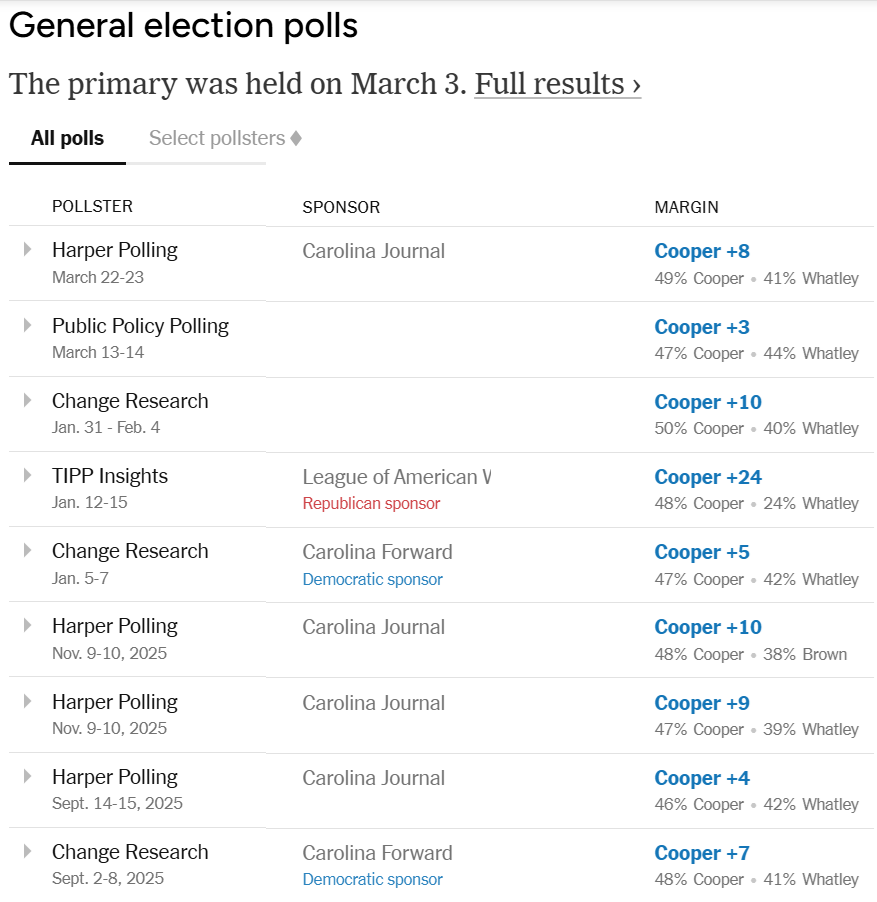
Polling averages show Cooper leading by ~5–8 points.
Example recent polls:
Cooper +6 (Emerson)
Cooper +3 (PPP recent)
Average: ~Cooper +7.5
That’s a meaningful but not safe lead in a swing state.
National political environment (BIGGEST factor)
Midterms typically serve as a referendum on the president. If Donald Trump (or the GOP nationally) is popular in November 2026, Republicans will gain momentum, shifting the race toward Whatley. If the national mood is anti-Republican or anti-Trump, the Democrats will surge, and Cooper’s lead will grow.
Impact level: Massive
Advantage: Cooper
Cooper’s Appeal to Independents
Roy Cooper’s popularity with independents stems from a combination of tone, record, and political positioning that aligns closely with what many nonpartisan voters tend to value. He has built a reputation as a pragmatic, center-left leader who emphasizes results over ideology, focusing heavily on everyday concerns like healthcare access, public education, and economic development rather than engaging in highly polarizing cultural or partisan battles. This issue focus makes him more relatable to independents, who often prioritize practical outcomes over party loyalty.
Additionally, Cooper has governed in a state where the legislature has been controlled by Republicans for most of his tenure, which has required negotiation and compromise. His ability to work within that divided government—reaching agreements on policies like Medicaid expansion—signals to independents that he is willing to collaborate and govern effectively even with political opposition. This stands in contrast to more partisan figures who may appear unwilling to compromise.
His personal style also plays a significant role. Cooper is generally considered calm, measured, and low-profile, avoiding inflammatory rhetoric or attention-grabbing political fights. In an era of heightened political polarization, this steady and predictable demeanor appeals to voters who are fatigued by conflict and prefer stability.
Finally, his consistent electoral success in a competitive swing state reinforces his credibility. Independents often search for candidates who can appeal broadly and win across party lines, and Cooper’s track record suggests he can do exactly that. Altogether, his moderate positioning, bipartisan approach, steady leadership style, and proven electability combine to make him especially attractive to independent voters.
Independents in North Carolina
North Carolina is a true swing state, meaning elections are usually very close between Democrats and Republicans. Because of that, neither party can reliably win with just its base. A large and growing share of voters in the state are unaffiliated (independent), and they frequently determine the outcome of statewide races like governor, U.S. Senate, and president.
These voters tend to be less ideologically rigid and more focused on candidate qualities such as competence, moderation, and issue priorities like the economy, healthcare, and education. They are also more likely to split their tickets—for example, voting for a Democrat in one race and a Republican in another—based on the individual candidates rather than party loyalty.
As a result, successful candidates in North Carolina usually need to win a significant portion of independents, especially in suburban and fast-growing areas. That’s why politicians like Roy Cooper, who can appeal beyond their party base, often perform well in statewide elections.
Whatley
In contrast to Cooper, Whatley—more closely aligned with national Republican Party leadership—could struggle to expand beyond the GOP base if the race centers on partisan or nationalized themes. Cooper’s calm, low-conflict leadership style and long track record of electoral success would reinforce perceptions of stability and effectiveness, while his established name recognition and political network would provide him a structural advantage in turnout and coalition-building. Altogether, these factors could enable Cooper to assemble a winning coalition of Democrats, independents, and a small share of crossover Republicans in a competitive general election.

Bottom line
Roy Cooper enters the 2026 U.S. Senate race with several key advantages rooted in his experience, positioning, and electoral track record. As a two-term governor and former attorney general, he has strong statewide name recognition and a long history of winning competitive elections, which signals credibility and electability to voters. And his moderate, pragmatic image allows him to appeal beyond the Democratic base, especially to independents and suburban voters who often decide close races in North Carolina.

